
Traverse Projected Versus Actual Release
The Traverse County roster uses the exact field “Sentence End Date” for some people who are still listed. MNDOC uses “Anticipated Release Date” for state prisoners under its jurisdiction. Both are forward-looking. The actual release is a completed custody event supported by a status change, notification, jail liberation entry, or receiving-agency record.
A pretrial person may have conditional bail or a court order, but there is no executed sentence from which to compute a fixed release date. The case can change through a hearing, dismissal, plea, new order, warrant, or hold. For a sentenced person, jail credit and the terms of the judgment matter. For state custody, MNDOC’s computation applies.
Do not treat an expired calendar date as proof. Check the current status afterward and obtain the completed record when precision matters.
Find Traverse County Release Dates
The search route starts with the sentence, not a generic inmate locator. The Traverse County release-record search helps identify whether the last custody was county, state, or federal.
- Check the Traverse current roster. If the person is listed, read Booking Date, Held For, and any Sentence End Date without treating them as release proof.
- Open the court case and read the sentence, jail credit, amendments, probation terms, and any order affecting custody.
- For a county sentence, call Corrections at 320-422-7800 and request the public computation behind the displayed Sentence End Date.
- For a Commissioner commitment, search the MNDOC Public Viewer by full name or six-digit ID.
- Match birth date, aliases, offense, and court-file number, then read Current Status, Anticipated Release Date, and Expiration Date.
- After the date passes, verify actual departure through status, notification, or the originating release record.
“Under Supervision” confirms that a person has left the physical prison while remaining under MNDOC jurisdiction. “Expiration Date” identifies the sentence or jurisdiction endpoint, not necessarily the day the prison gate opened. Fully discharged people may disappear from Public Viewer, so DOC Records becomes the historical route.
Traverse Release Date Fields
The county and state systems use similar-looking dates for different legal settings. Reading the label and source prevents a county sentence from being confused with a state-prison projection.
| Field or status | Meaning |
|---|---|
| Traverse Sentence End Date | A prospective local roster field for some sentenced people presently held. |
| MNDOC Anticipated Release Date | The state’s current projection for prison departure, subject to computation changes. |
| MNDOC Current Status | Shows whether the person is incarcerated, under supervision, or in another listed state status. |
| Under Supervision as of date | Confirms physical prison release with continued DOC jurisdiction. |
| Expiration Date | The endpoint of the sentence or DOC jurisdiction, not always the prison-release day. |
| Court sentence and jail credit | The judicial basis and credited time used in later computation. |
MNDOC detail records may also show sentence date, caseworker, offense, and court-file number. Those fields help connect the projection to the right case and provide a contact route for a computation question.
The official two-thirds and one-third statute provides the foundation for ordinary modern executed felony sentences.
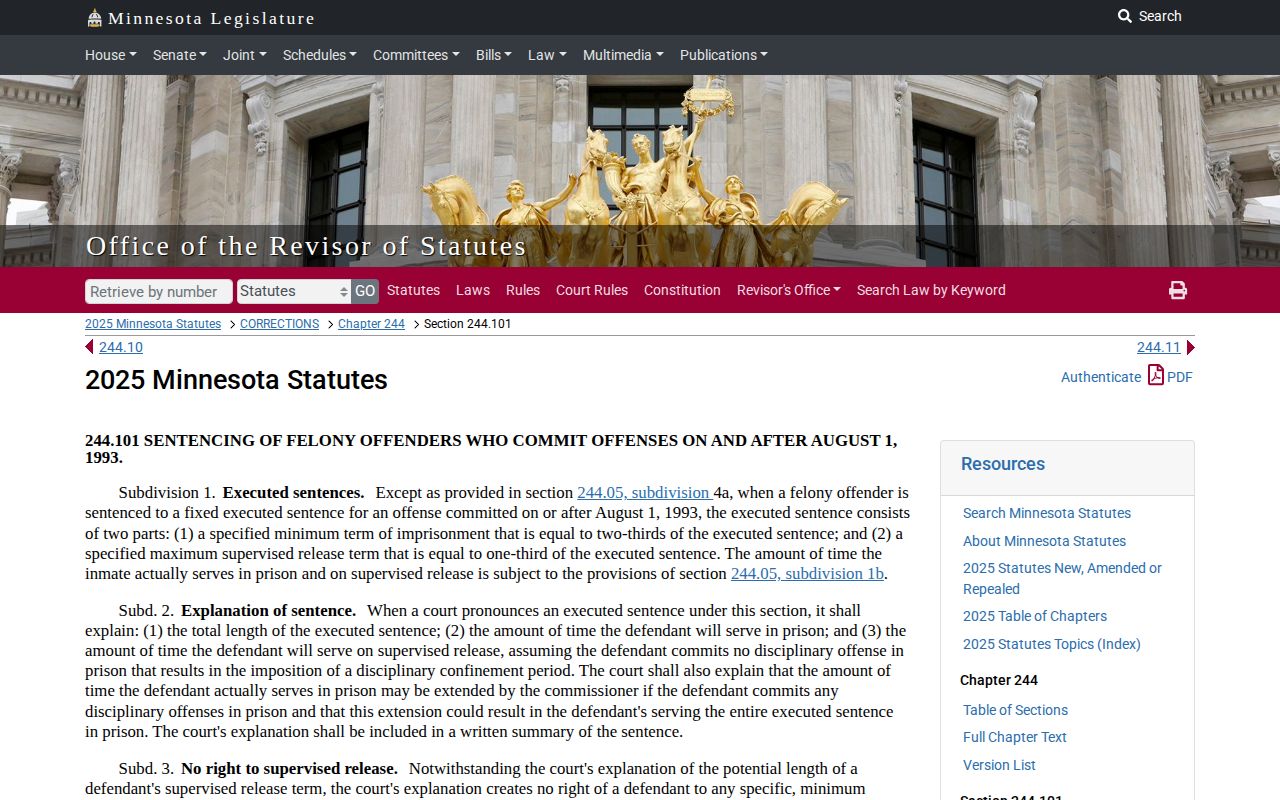
The statute supplies a framework, while MNDOC remains responsible for the person-specific date shown in its record.
Minnesota Two-Thirds Release Framework
Minnesota’s modern default is not an 85-percent rule. Under section 244.101, an ordinary fixed executed felony sentence for an offense on or after August 1, 1993 is divided into a minimum two-thirds prison term and a maximum one-third supervised-release term. The entire executed sentence continues through the community portion.
Section 244.05 provides that release follows the imprisonment term plus disciplinary confinement. Discipline or refusal of required programming can delay prison departure. In the ordinary case, that delay reduces the community portion rather than extending the total court-imposed term.
This state-prison framework does not calculate a short Traverse County jail sentence. For the local jail, ask Corrections how it computed the roster’s Sentence End Date and request the computation record. Use the court judgment to check sentence length, concurrent or consecutive treatment, and jail credit.
Note: Supervised release is the community portion of a prison sentence, not the same event as final discharge from MNDOC jurisdiction.
Traverse Earned Incentive Questions
The Minnesota Rehabilitation and Reinvestment Act created earned incentive release under sections 244.41 through 244.45. Section 244.44 authorizes up to 17 percent of the total executed sentence in eligible earned incentive credit. It cannot reduce prison time below one-half, does not shorten the total sentence, and permits revocation for violations or criminal acts.
The program excludes life sentences, specified indeterminate sentences, and old-law good-time cases. Implementation is phased. MNDOC policy became effective on February 2, 2026, with initial facilities and broader implementation projected through 2027. A reader must not simply subtract 17 percent from the sentence or from a displayed date.
Ask MNDOC whether the person and facility are eligible, what credit was actually earned, and how the Anticipated Release Date reflects it. The court sentence remains the total term, while credit can change the division between prison and supervision within the statutory limits.
The earned incentive credit source shows the limits that govern the calculation.
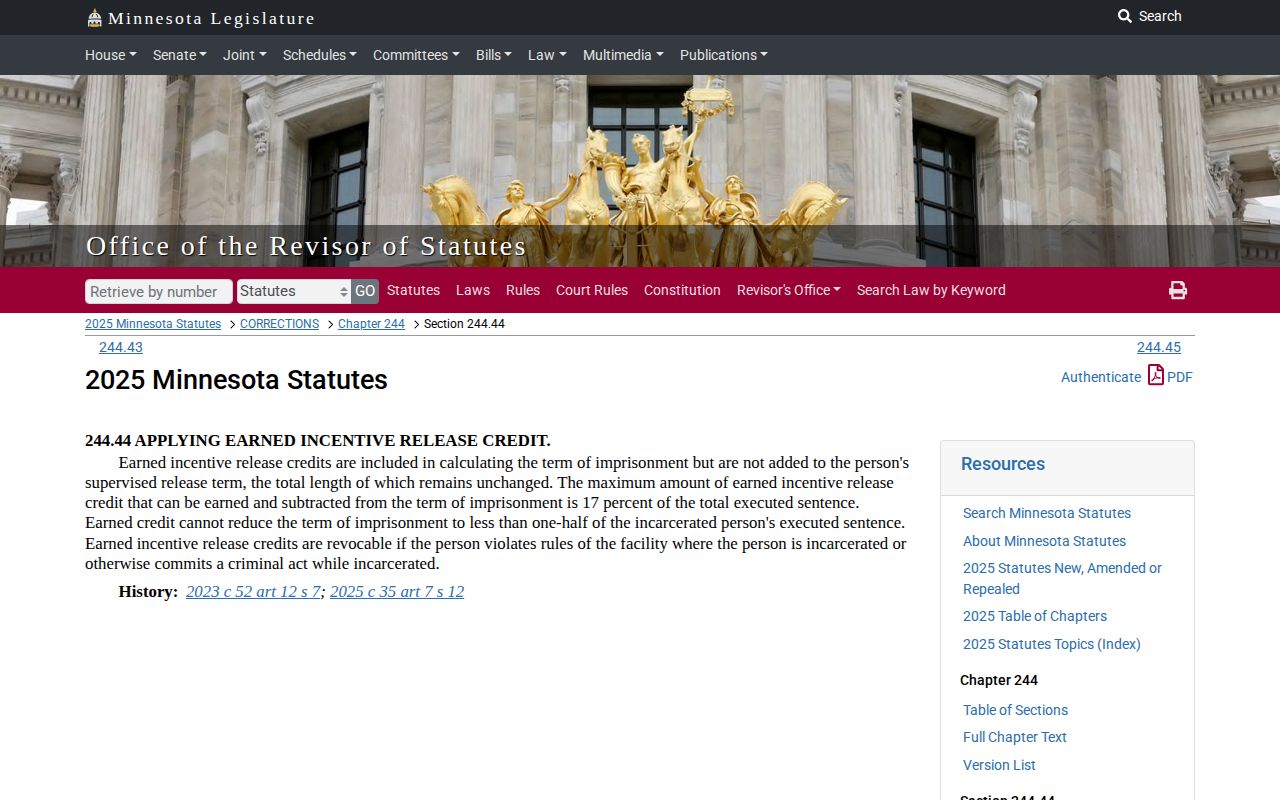
The official text shows why eligibility and earned credit must be confirmed person by person.
Why Traverse Release Dates Change
A projected release date reflects the information and legal rules applied at that time. Later events can move the date or change where the person goes. Some factors change the prison portion. Others do not change the date but prevent a release to the community.
| Factor | Possible effect |
|---|---|
| Jail credit or sentence computation | Changes the credited time or the start point used in calculation. |
| Concurrent or consecutive sentences | Changes how multiple terms run together or one after another. |
| Disciplinary confinement | Can delay state-prison departure under section 244.05. |
| Earned incentive credit | May alter eligible prison time after confirmed participation and credit. |
| Court amendment or new order | May change the sentence or the authority for continued custody. |
| Detainer or other-agency hold | May cause transfer instead of release to the community. |
| Board action | May affect the narrow life, indeterminate, or juvenile early-release caseload. |
The Minnesota Supervised Release Board is not the gate for every modern prison sentence. Its public-facing work concerns a limited eligible group. Ordinary determinate supervised release generally follows the statutory sentence structure without a universal parole hearing.
Request Traverse Sentence Computations
A displayed date can answer a basic planning question, but a computation record explains the arithmetic and legal inputs. For a Traverse County jail sentence, ask Corrections for the public calculation supporting the Sentence End Date. Identify the booking and court case, and request the sentence length, jail credit, start date, concurrent or consecutive treatment, and any public adjustment reflected in the date.
For state prison, contact MNDOC Records at 651-361-7330, fax 612-473-5006, or CO-Records.DOC@state.mn.us. Give the six-digit offender ID, aliases, birth date, and court-file number when known. Ask for the Anticipated Release Date calculation, recalculated dates, release to supervision, Expiration Date, final discharge, and public sentence-computation material. Inspection of public DOC data can be requested as an alternative to copies.
If part of a computation is private corrections data, request the segregable public portions and the statute used for each withholding. Medical, psychological, financial, security, investigation, informant, and unrelated personal data can have protection under Minnesota law. Those limits do not justify guessing at a date from the court sentence alone.
Note: The agency that computes the date is the best source for explaining a change in its own displayed field.
Minnesota Weekend Release Date Rule
State law has an unusual date split. Under section 244.05, subdivision 1a, a state-prison release date falling on Friday, Saturday, Sunday, or a holiday is handled differently based on the offense date. For an offense before August 1, 1992, it moves to the preceding qualifying weekday. For an offense on or after that date, release begins on the first qualifying day after the scheduled date.
This is a MNDOC prison rule. No official source states that Traverse County Jail follows the same schedule, and no local weekend-release procedure was found. Do not use the state statute to promise when someone will leave the Wheaton jail. Call Corrections and ask about that booking.
Earned incentive credit adds another possible state calculation issue, but it is phased and not automatic. The offense date, sentence class, discipline, credit, and program status all matter. This combination makes the displayed MNDOC date more reliable than a calculation made from the sentence alone, though it remains anticipated.
Traverse Court Dates and Holds
The Traverse court file supplies the legal base for the computation. Read the judgment for the executed term, jail credit, probationary disposition, concurrent or consecutive directions, and later amendments. A bail or release order matters for a pretrial person, but it does not create a sentence-based projection. Another warrant or hold can also prevent departure after the court authorizes release.
MCRO person-name searching may omit a pending criminal case with no conviction. Use a case or citation number when possible, or contact Traverse County District Court. The Register of Actions can show the order, dismissal, sentence, revocation, or discharge. Its timestamps still do not replace the jail’s operational record.
The roster’s “Held For” field should travel with every date check. If Stevens, Grant, Big Stone, ICE, or another authority is named, ask that agency whether it will receive the person. The anticipated end of one hold may mark transfer to the next custodian rather than entry into the community.
Note: A detainer affects destination and custody continuity even when the sentence computation itself remains unchanged.
Confirm Traverse Actual Release
For a county sentence, confirm the completed event through the Traverse jail, Minnesota VINE, the court case, and the permanent liberation record. The record required by section 641.05 should state when and by what authority the person was liberated. A transfer record may identify the receiving custodian.
For state prison, read Current Status after the Anticipated Release Date. “Under Supervision” confirms prison departure with continuing jurisdiction. Register with Minnesota Haven for prison and supervision notifications. The Traverse County VINELink check remains the correct alert path for county-jail events, not MNDOC prison events.
For a fully discharged state prisoner who no longer appears, contact MNDOC Records at 651-361-7330 or CO-Records.DOC@state.mn.us. Request the release-to-supervision date, recalculated dates, Expiration Date, final discharge, and public computation material. A federal case must be checked in BOP, ICE, or the federal docket instead.
Note: Actual release confirms departure from one custodian, while another hold may still lead directly to a receiving agency.