
Traverse County 72-Hour Release Status
No official 72-hour, 48-hour, or released-person archive was found in the Traverse County sheriff sources. The available roster landing page leads to a current PDF. It answers who is represented as held when the PDF was printed. It does not answer who left during the prior three days.
The county does not publish the PDF’s update cadence or retention window. A missing name may reflect release, transfer, return to a holding agency, state commitment, federal handoff, or another custody change. Saving and comparing rosters can reveal a disappearance, but the result is not a lawful substitute for a release event. It supplies no time, authority, reason, or destination.
Check Traverse Three-Day Releases
A multi-day inquiry should be organized by event date and custodian. Record the last date the person appeared on the current roster, then work forward. The Traverse County 24-hour release workflow is better when the question is limited to today.
- Open the current roster and note its printed date. Confirm whether the person still appears and read the “Held For” agency.
- Search Minnesota VINE by name, alias, or offender ID for a county-jail status or custody-change event.
- Call Traverse Corrections at 320-422-7800. Ask about current custody and the route to a public release or transfer record.
- Open the matching Traverse or other county court case. Read the Register of Actions for bond, dismissal, sentence, credit, or release orders.
- Request the permanent jail record for the exact three-day period when an official historical answer is required.
VINE can be quick, while court entries explain legal authority. Neither should be treated as a complete liberation record. An order may exist before jail processing ends, and VINE may not state the destination. The sheriff’s record can connect date, authority, and transfer information when those facts are public.
Traverse County Three-Day Fields
There are no official 72-hour release-list columns because there is no county feed. The following table separates the roster clues that do exist from the release facts that must come from another source.
| Available roster field | What it does and does not prove |
|---|---|
| Printed on / Total Records | Dates the current snapshot and counts its entries, but supplies no historical window. |
| Name, age, Front Mugshot | Helps identify a current booking, not a former inmate’s release. |
| Booking Date | Shows when custody began for the listed booking, not when it ended. |
| Held For | Points to the agency that may receive or continue custody after departure. |
| Conditional Bail Amount | Shows a possible court condition, not payment or physical release. |
| Sentence End Date | Provides a future field for some currently held people, not an actual event. |
A complete Traverse County release inquiry asks for date and time liberated, legal authority, type of liberation, and destination or receiving agency if public. These details are absent from the live PDF. That gap is why a three-day records request is more sound than a roster reconstruction.
Traverse Weekend Release Checks
A three-day window is often useful because it spans a weekend, a holiday, or delayed court entry. Traverse County, however, publishes no weekend release schedule and no local rule stating when releases are processed. The Communications/Corrections operation is staffed around the clock, but round-the-clock staffing does not establish public record hours or promise a release at any set time.
The court calendar also cannot close this gap. A hearing schedule reports proceedings, not actual custody. A judge may order release, yet another hold or administrative step can keep the person in custody. On the next business day, check the Register of Actions and contact the jail. Ask the court for a copy if an order is not remotely available.
Minnesota has a separate weekend and holiday rule for state-prison release dates under section 244.05. That statute must not be applied as Traverse County Jail policy. County release timing remains unreported in the official local sources.
Note: Call before travel because no official source gives a Traverse release time, exit point, waiting area, or property-return procedure.
Traverse Court Records Across 72 Hours
Minnesota Court Records Online can show the legal action behind a custody change. Search the Traverse criminal or traffic file and open Case Details and the Register of Actions. Useful entries include bail or release orders, dismissal, conviction, jail credit, time served, probation, revocation, amended sentence, and discharge. The record can explain why release was authorized even when it does not show the precise minute Corrections completed it.
Ordinary person-name search has a key gap: a pending criminal case with no conviction is not returned that way. Search a known case or citation number, try documented name variants, or contact Traverse County District Court. The court is at 702 Second Avenue North, PO Box 867, Wheaton, MN 56296, and its public hours are Monday through Friday, 8:00 a.m. to 4:30 p.m. The daily calendar posts on business days and updates hourly, but it remains a schedule rather than custody proof.
Remote document access also varies by filing date and record type. A missing online document may still be inspected at the courthouse. If access is restricted or a case has been sealed, do not rebuild the contents from unofficial sources. Ask the court what public material remains available.
Note: A judicial release order and a completed physical release are related records, but they are not the same event.
Request Traverse Liberation Records
Minnesota Statutes section 641.05 requires a permanent jail record that includes when and by what authority a person was liberated. This statutory record is the central historical source after the roster changes. A three-day request should identify the person, approximate booking date, and the date range in question.
Ask the Traverse County Sheriff’s Office for the booking sheet, permanent record entry, date and time liberated, authority or type, destination or receiving agency if public, and transfer record. The office is at 203 Seventh Street North, PO Box 826, Wheaton, MN 56296. Requests may seek inspection, copies, or both. The county policy allows cost categories based on labor, copy format, mailing, media, and other work, so request an estimate.
For a state-prison case, use the MNDOC offender-record request, not the sheriff’s county record. Ask for release to supervision, anticipated or recalculated dates, expiration, and final discharge. For a federal case, the BOP locator or federal records path applies. Each system documents its own custody.
The Traverse Sheriff administration page provides the current records and fee context.
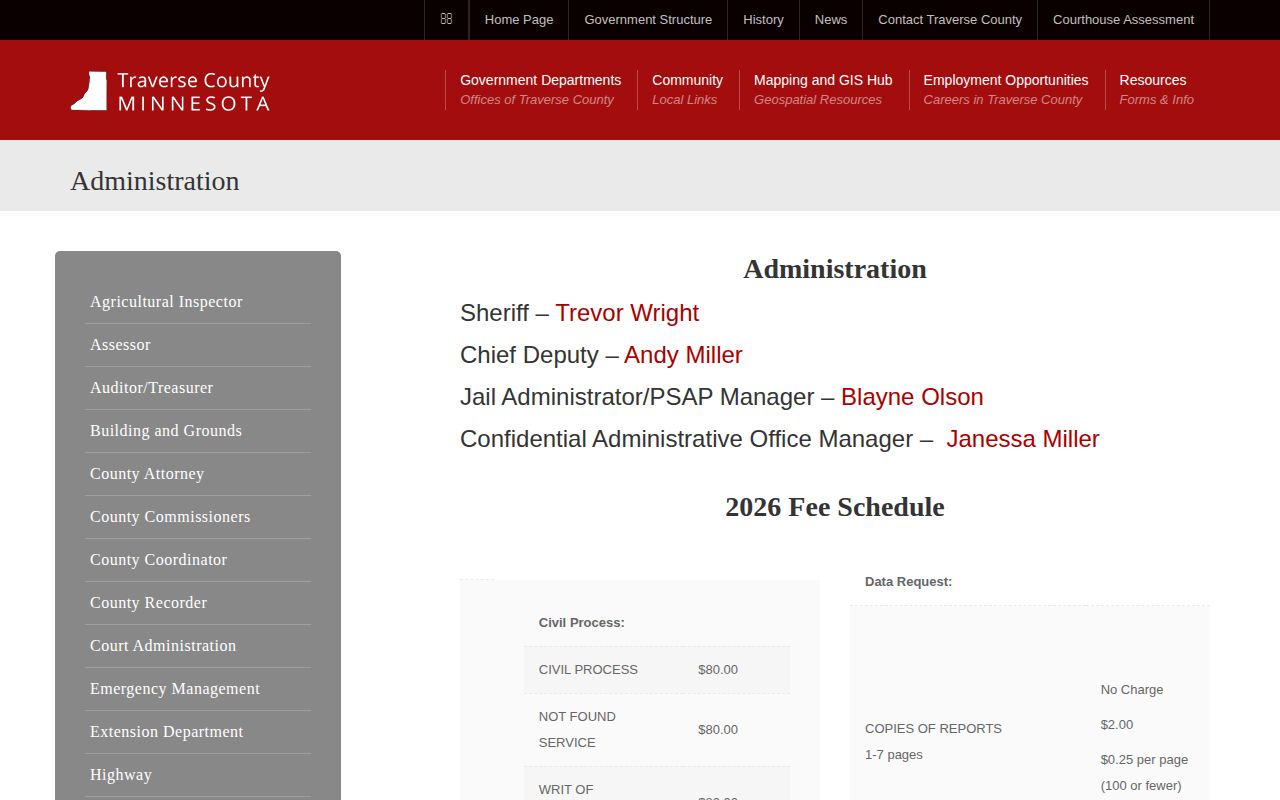
This official source supports the records route when the generated roster no longer shows the booking.
Traverse Release Versus Transfer
The jail’s interagency role makes destination a core question. In the 2025 sheriff report, only part of the people held were held for Traverse. Stevens, Grant, Big Stone, other agencies, and ICE also appeared. A person can leave the Wheaton building while remaining in uninterrupted custody.
- Community release
- A source confirms departure from custody without a receiving custodian.
- Transfer
- One authority delivers the person to another jail, DOC, federal agency, medical placement, or other custodian.
- Court disposition
- The judicial outcome or order. It may authorize release but does not prove the exact physical time.
- Final discharge
- The end of DOC jurisdiction, which is different from leaving prison under supervision.
For a county event, VINE and the permanent record are the primary paths. For a Minnesota prison release, MNDOC may show “Under Supervision,” while Minnesota Haven handles notifications. BOP and ICE use separate federal tools. The county roster cannot verify any later state or federal release.
Traverse Roster Retention Is Unknown
Traverse uses a regenerated, date-stamped PDF at a stable address. No archive, stated posting cycle, sheriff app, or release-history search was verified. Search-engine copies may differ from the live file, but that observation does not establish policy. Cached material can be stale and still cannot explain why a person left the list.
The sound three-day approach is to keep dates from official events and obtain the originating record. For a named person whose release may fall outside the window, use the full Traverse County release search. Confirm all results with the agency that held the person. Do not substitute an unofficial county-branded page or app. Several such sources describe tools and addresses that do not match the official Traverse system, and none can establish the completed release.
Note: “Not found” is not a release status because spelling, aliases, transfer, full discharge, restricted data, or another jurisdiction can cause no result.